

















The San Diego Life Sciences Leadership Market Is Shrinking and Short-Handed
By Fernando Espinosa Ramirez, Top Notch Finders CEO and Chief Talent Officer
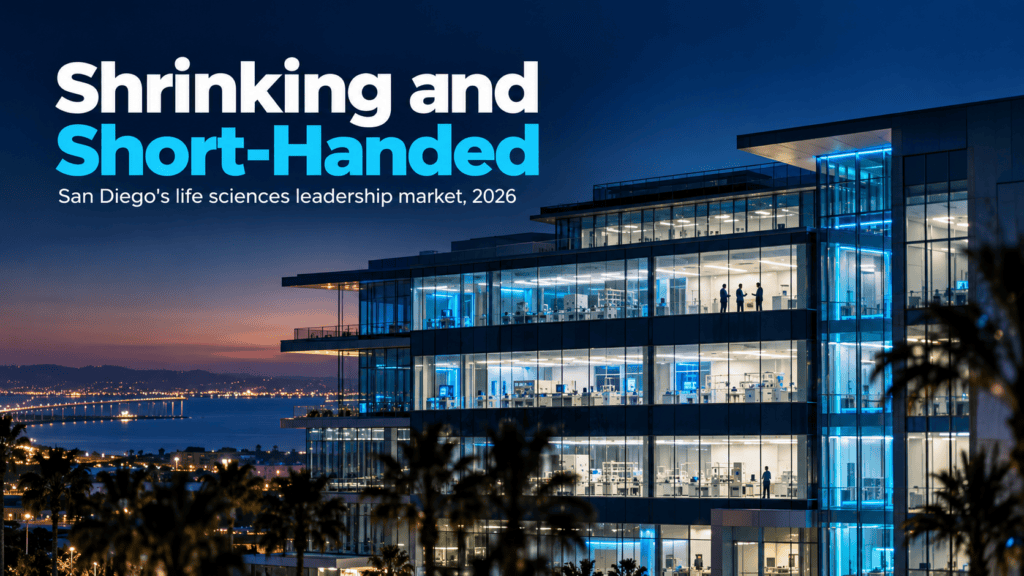
San Diego’s life sciences jobs fell 2.55% in 2025, yet 64% of biopharma organizations were actively hiring at year end. The gap is a three-tier workforce split driven by AI: a scarce hybrid tier, a transforming middle and an exposed tier. HR sits at the intersection, and California already regulates its AI tools.
Fernando Espinosa Ramirez wrote this paper for the Biocom California HR Conference 2026, drawing on TNF’s segmentation of more than 120 employers connected to the conference. Inside: the six employer types and the first HR problem each one faces, the California and EU regulatory dates already on the calendar, the five leadership profiles this shift requires and a 90-day plan. Download the full white paper for the tier-by-tier evidence and the plan.
Four conclusions
1. The binding constraint has moved from models to people and data. 77% of labs expect to use AI within two years, while the share citing a lack of skilled people rose from 23% to 34% in one year.
2. Build before you buy. 67% of AI-using biotechs grow AI talent by upskilling existing scientists, and only 21% hire from technology companies.
3. HR’s own AI is now regulated. California’s automated-decision system rules under FEHA have applied since October 1, 2025.
4. Leadership is the multiplier. Only 22% of AI-using biotechs run AI workflows that span multiple R&D teams.
Frequently asked questions
Is San Diego’s life science workforce shrinking or hiring?
Both. Biocom California counts 61,866 direct life science jobs in San Diego for 2025, down 2.55%, which it attributes mainly to funding and federal policy instability. Yet 64% of biopharma organizations told BioSpace they were actively hiring at the end of 2025, and CBRE data show core R&D and pharma manufacturing employment growing 1.7% by April 2026.
What is the three-tier workforce split?
The paper describes a scarce premium tier of people who combine biology with data, automation or regulated quality skills; a transforming middle of bench scientists, QC analysts and clinical operations staff whose tasks are changing; and an exposed tier of routine work and experienced talent released by restructuring. Tiers are set by task mix, not job title.
Where do AI-using biotechs find AI talent?
In Benchling’s 2026 survey, 67% of AI-using biotechs source AI talent by upskilling existing scientists, 39% hire from AI-focused biotechs, 32% from biopharma and only 21% from technology companies. The paper argues HR should fund structured, measured upskilling pathways rather than hoping to hire its way out.
Which regulatory dates should life science HR teams put on the calendar?
California’s automated-decision system rules under FEHA have applied since October 1, 2025. CCPA automated decisionmaking rules reach employers on January 1, 2027, and EU AI Act high-risk obligations for HR tools apply from December 2, 2027. Timelines may change, so confirm obligations with counsel.
Which leadership profiles does this shift require?
The paper names five: the translational scientist-leader, the lab automation and digital operations leader, the GxP AI quality and validation leader, the AI-literate CHRO or People leader, and the binational operations leader. The scarce skill they share is integration: making disciplines work together under regulatory constraint.
What should HR do in the first 90 days?
Days 1 to 30: inventory AI tools in HR, confirm FEHA compliance and publish an interim generative AI policy. Days 31 to 60: map AI exposure for the top five role families, run an AI literacy baseline and select a first bilingual scientist cohort. Days 61 to 90: set CCPA readiness milestones, align pay benchmarks and brief the board.
This is general information, not legal advice. Confirm your specific obligations with employment counsel.
The algorithmic transformation of our industry will be decided less by which models we buy than by which people we develop, which leaders we choose, and how responsibly we use AI on our own workforce. If this paper raises questions for your organization, I would welcome a conversation about your leadership needs across San Diego and the CaliBaja corridor.
Related reading: our life sciences hiring guide, life sciences executive search, and the CaliBaja hiring guide.
The Algorithmic Transformation of Life Science Human Capital
Get the full white paper: the three-tier workforce split, the regulatory calendar HR cannot ignore, five leadership profiles and a 90-day plan.